Automate insurance claims with intelligent workflows
End-to-end claims processing powered by AI document extraction, policy validation, and automated decision-making — deployed on IBM Cloud with watsonx Orchestrate integration.

Intelligent Process Flow
From claim submission to resolution — fully automated
The demo showcases an end-to-end AI-powered claims processing system built on three core components working together seamlessly:
How the Demo Works
1. Mailbox Emulator — Customers submit claims via email with attachments. The emulator stores the email content in Db2 and attachments in Cloud Object Storage, then triggers the workflow engine with a unique claim ID.
2. draw.io Workflow Engine — Executes the visual workflow diagram shown below. Each process node is defined with business logic and task descriptions directly in the draw.io model. The engine orchestrates the entire claims journey from intake to resolution.
3. External Task Executor — When the workflow reaches a process node, it sends a REST call to this component. The executor leverages watsonx Orchestrate (powered by watsonx.ai) to perform AI operations like document extraction and policy validation, updates Db2 with results, and returns data back to the workflow engine for the next step.
The Result: A fully automated claims process where customer intake via email triggers AI-powered document analysis, policy validation, automated decision-making, and intelligent routing for complex cases — all orchestrated by a visual workflow that business users can understand and modify.
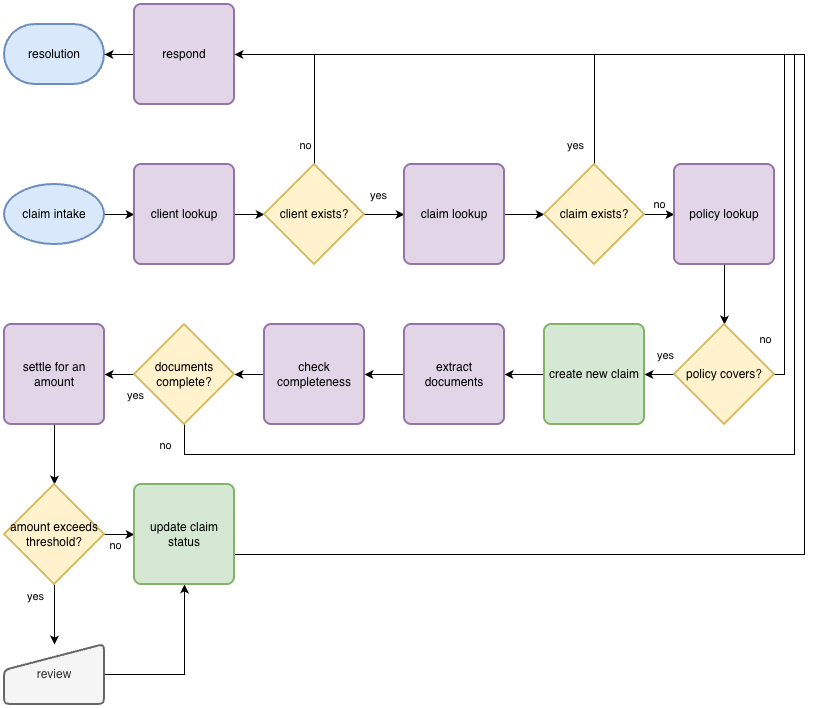
Workflow Color Coding
Note: All rounded square shapes represent tasks where the workflow engine sends a REST request to the external task worker application. The color indicates whether AI is used to process that task.
Cloud-Native Architecture
Built on IBM Cloud with enterprise-grade services
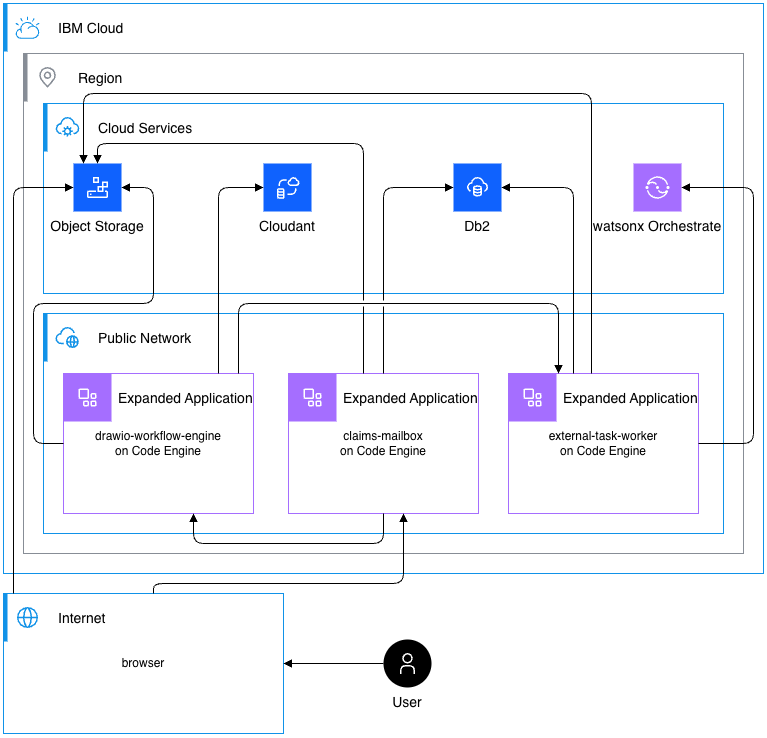
The entire solution runs on IBM Cloud, leveraging serverless compute, managed databases, object storage, and AI services. The architecture diagram below shows how all components interact to deliver a seamless claims processing experience.
Architecture Deep Dive
Internet Layer — Users access the system through their web browser. All web pages (including this demo page and the mailbox interface) are hosted on IBM Cloud Object Storage and served over HTTPS. This provides global availability and eliminates the need for web server infrastructure.
IBM Code Engine (Serverless Compute) — Three containerized applications run as serverless workloads with automatic scaling:
- claims-mailbox: Receives email submissions, stores content in Db2, uploads attachments to COS, and triggers the workflow engine
- drawio-workflow-engine: Loads workflow models from COS, executes the process flow, maintains state in Cloudant, and coordinates between components
- external-task-worker: Receives REST calls from the workflow engine, executes AI operations via watsonx Orchestrate, and updates Db2 with results
IBM Cloud Object Storage (COS) — Serves multiple purposes in the architecture:
- Hosts all static web pages (HTML, CSS, JavaScript)
- Stores draw.io workflow model files (.drawio format) that define the business process
- Securely stores claim attachments (photos, PDFs, documents) uploaded by customers
- Provides 99% durability and global accessibility
IBM Db2 (Transactional Database) — Stores all structured data with ACID compliance:
- Customer profiles and policy information
- Email content and metadata (sender, subject, timestamps)
- Claim records and processing history
- References to attachments stored in COS (object keys)
IBM Cloudant (NoSQL Database) — Maintains workflow execution state for distributed processing:
- Current position in the workflow for each claim
- Context variables passed between process nodes
- Wait states for manual approvals or scheduled delays
- Enables workflow resumption after interruptions or system restarts
watsonx Orchestrate — Provides AI-powered automation capabilities:
- Document analysis and data extraction from images and PDFs
- Natural language processing for email content understanding
- Intelligent decision-making based on policy rules and claim details
- Powered by watsonx.ai foundation models
Component Interaction: When a user submits a claim through the web interface (hosted on COS), the mailbox app (on Code Engine) stores data in Db2 and COS, then triggers the workflow engine (on Code Engine). The engine loads the process model from COS, maintains state in Cloudant, and calls the task worker (on Code Engine) which uses watsonx Orchestrate for AI operations. All components communicate securely within the IBM Cloud region, while users access the system through the public internet.
Key Capabilities
Everything needed for modern claims processing
Built with enterprise requirements in mind: scalability, security, compliance, and seamless integration with existing systems.
AI Document Analysis
Automatically extract claim details from photos, PDFs, and scanned documents using watsonx AI capabilities. No manual data entry required.
Policy Validation
Real-time validation against policy terms, coverage limits, and exclusions. Ensures 100% compliance with underwriting rules.
Automated Decisions
Claims within defined thresholds are automatically approved and settled. Reduces processing time from days to minutes.
Intelligent Routing
Complex cases automatically escalated to human agents with full context and AI recommendations for faster resolution.
Email Integration
Customers submit claims via email. System automatically processes attachments, extracts data, and sends status updates.
Audit Trail
Complete history of every claim action stored in Db2. Full compliance with regulatory requirements and internal policies.
Technology Stack
Powered by IBM Cloud and open standards

Serverless container platform with auto-scaling and zero infrastructure management

Enterprise-grade relational database for customer and policy data

Scalable storage for claim attachments with 99% durability

NoSQL database for distributed workflow state management

AI-powered automation for document analysis and intelligent routing

Backend services with REST APIs for workflow orchestration

Visual workflow modeling executed as stateful processes

OCI-compliant containerization for consistent deployments
Ready to Experience It
Try the live demo
Submit a test claim through the interactive mailbox interface and watch the AI-powered workflow process it in real-time. See document extraction, policy validation, and automated decision-making in action.